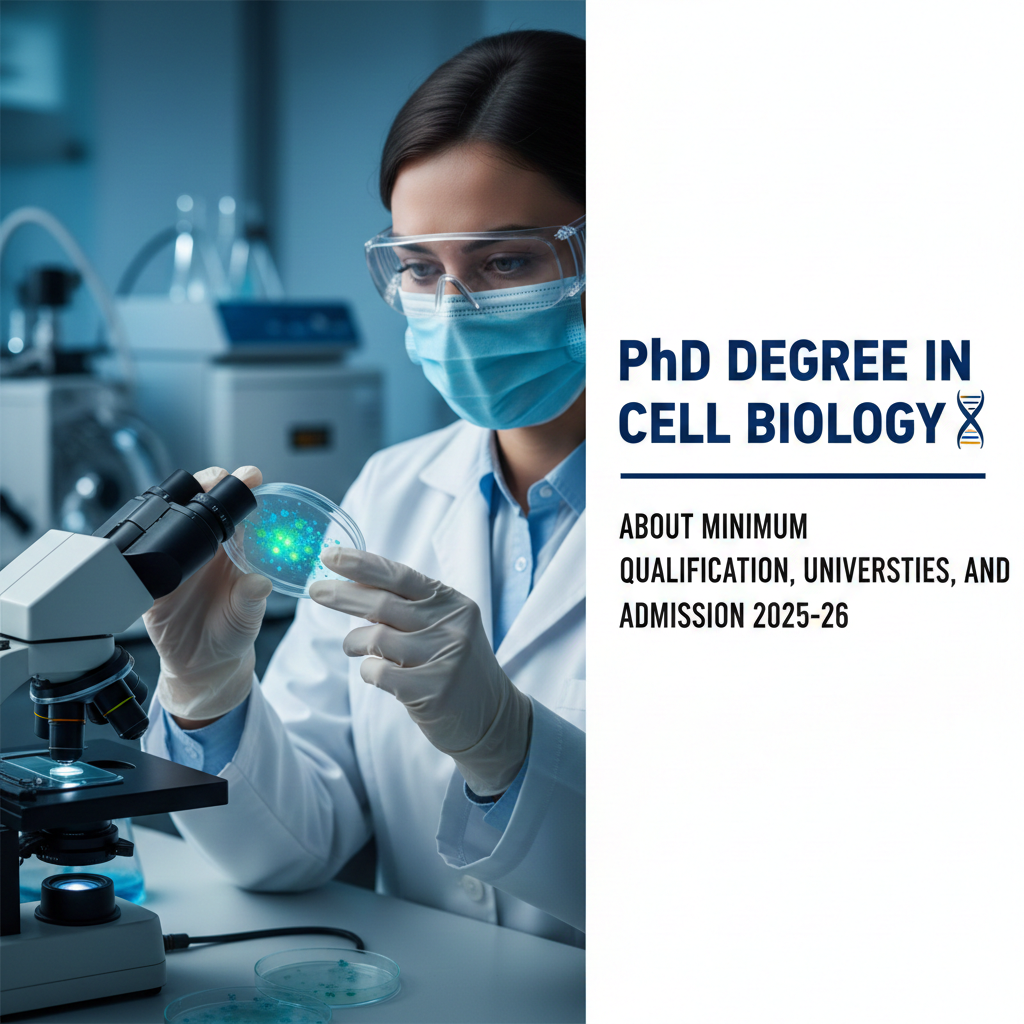
PhD Degree in Cell Biology - About Minimum Qualification, Universities, And Admission 2025-26
About This Course
A PhD in Cell Biology opens the door to an in-depth, three to four-year research journey focused on understanding how cells function at their most fundamental level. During this period, scholars explore complex biological processes such as cell-to-cell communication, stem cell applications, and the key differences between healthy cells and those affected by disease. This research not only advances scientific knowledge but also contributes directly to solving real-world health and biological challenges, making the work both impactful and deeply rewarding.
The graduate program in Cell and Developmental Biology offers both M.Sc. and Ph.D. degrees, designed for students seeking advanced training and research exposure in this dynamic field. One of the program’s major strengths lies in its flexibility. It welcomes students from diverse academic backgrounds and allows them to tailor their learning and research paths according to their interests, reflecting the broad and interdisciplinary nature of cell and developmental biology.
The curriculum is carefully structured to provide a strong foundation in modern scientific principles, experimental techniques, and research methodologies. From the very beginning of the program, students are actively involved in original and meaningful research, ensuring hands-on experience alongside theoretical learning. With nearly 50 faculty members engaged in cutting-edge research, students benefit from mentorship across a wide range of specializations and emerging research areas.
Admissions to the Department of Cell Biology are primarily through the Graduate School and various training grant programs, including Cell and Molecular Biology, Developmental Biology, and Genetics and Genomics. Students have the freedom to affiliate with any participating program member, further enhancing interdisciplinary collaboration. Institutions like Duke stand out for their exceptional diversity of training programs, spanning fields such as Structural Biochemistry and Biophysics, Pharmacological Sciences, Molecular Cancer Biology, Developmental and Stem Cell Biology, Bioinformatics, and Computational Biology. This rich academic environment ensures that graduates are well-prepared for impactful careers in research, academia, and beyond.
Eligibility
To pursue a PhD in Cell Biology, candidates must meet specific academic and research-oriented eligibility criteria, which may vary slightly depending on the university and country. In general, applicants are expected to have a strong academic background in Life Sciences or Biology, along with a clear interest in research.
Most universities require a Master’s degree in Biology, Life Sciences, Biochemistry, Molecular Biology, or a closely related discipline, with a minimum of 55–60% aggregate marks or an equivalent grade. Strong academic performance throughout undergraduate and postgraduate studies is highly valued.
In some cases, candidates with a strong 4-year Bachelor’s degree—such as B.Sc. (Honours), B.S., B.E., B.Tech, or equivalent degrees in Science, Engineering, or Pharmacy—may also be considered for direct PhD admission. This pathway is more common for applicants who demonstrate exceptional academic merit and hold a valid national-level fellowship, such as a high GATE score or JRF qualification.
A well-defined research proposal is an essential part of the application process. It should clearly outline the research problem, objectives, methodology, and relevance of the proposed study. Additionally, applicants are usually required to submit Letters of Recommendation (LORs) from academic or research mentors who can attest to their research potential and academic capabilities.
In India, many institutions require candidates to qualify for national-level examinations or fellowships such as GATE, CSIR-UGC NET, DBT JRF, or ICMR JRF. International applicants, or those applying abroad, may need to submit standardized test scores such as GRE, along with English proficiency scores like TOEFL or IELTS.
The final stage of admission typically includes a personal interview, where candidates are assessed on subject knowledge, research aptitude, and alignment with faculty expertise. Since eligibility and selection criteria differ across institutions, applicants are advised to carefully review the specific requirements of each PhD Cell Biology program before applying.
PhD Degree in Cell Biology Admission Process
The inStem Ph.D. program is a highly competitive and research-intensive doctoral program designed to attract outstanding candidates with strong academic and scientific backgrounds. Admission to the program follows a rigorous and multi-stage selection process to ensure the highest standards of research excellence.
To be eligible, candidates are typically required to hold a Master’s degree in any basic science discipline, such as biology, biotechnology, biochemistry, chemistry, or related fields. In addition to academic qualifications, applicants must have successfully qualified in national-level entrance or fellowship examinations, including CSIR-NET, UGC-NET, DBT-BET, INSPIRE, or ICMR. These qualifications demonstrate a candidate’s research aptitude and subject knowledge, which are essential for advanced doctoral training.
Eligible candidates are required to submit a complete application package, which generally includes academic records, proof of fellowship or eligibility exam qualification, and other supporting documents. Based on the strength of this application package, candidates are shortlisted for interviews. The shortlisting process is highly selective and focuses on academic performance, research potential, and alignment with inStem’s research areas.
Candidates who successfully clear the interview stage are offered admission to the program and are registered at the Regional Centre for Biotechnology (RCB). RCB is an Institute of National Importance, established by the Department of Biotechnology (DBT), Government of India, in collaboration with UNESCO, and serves as the academic partner for the inStem Ph.D. program.
Final registration at RCB is conditional upon the successful completion of coursework and a comprehensive examination. This examination evaluates the candidate’s understanding of core biological concepts, as well as their ability to formulate meaningful research questions and design appropriate methodologies. Only candidates who meet these academic and evaluative standards are formally registered as Ph.D. scholars, ensuring a strong foundation for high-quality research.
Future Scope
A PhD in Cell Biology offers a wide spectrum of career opportunities across academia, industry, and government sectors. With advanced expertise in cellular structure, function, and disease mechanisms, graduates are well prepared to contribute to cutting-edge research, innovation, and policy-making within the life sciences domain. The growing global focus on healthcare, biotechnology, and drug development has created strong demand for skilled cell biologists.
In academia and research, PhD graduates commonly pursue roles such as University Professors or Lecturers, where they combine teaching with independent and collaborative research. Many also work as Research Scientists in universities, medical schools, and government-funded laboratories, including national research institutes. These roles involve designing experiments, publishing scientific findings, mentoring students, and securing research funding. Key research focus areas include neurobiology, stem cell biology, cancer biology, immunology, and developmental biology, all of which play crucial roles in understanding human health and disease.
The biotechnology and pharmaceutical industries offer equally promising career paths. Cell Biology PhD holders work as biotech or pharmaceutical scientists, contributing to drug discovery, translational research, and product development. Opportunities also exist in research and development (R&D), regulatory affairs, quality control, and clinical research, where scientific expertise supports innovation, compliance, and commercialization. Roles such as Molecular Biologist, Geneticist, Biotechnologist, Medical Scientist, and R&D Specialist are common in this sector.
In the government and public sector, graduates can work in national research laboratories, healthcare agencies, and policy-making bodies, helping to guide scientific research agendas and health-related regulations. Some professionals transition into science management, technical advisory, or policy roles, where their deep understanding of cellular processes informs strategic decision-making.
Overall, a PhD in Cell Biology equips graduates with versatile skills applicable to research, management, technical leadership, and policy, enabling impactful careers across multiple sectors of the life sciences.
No universities found offering this course yet.
Apply for PhD Degree in Cell Biology - About Minimum Qualification, Universities, And Admission 2025-26 at