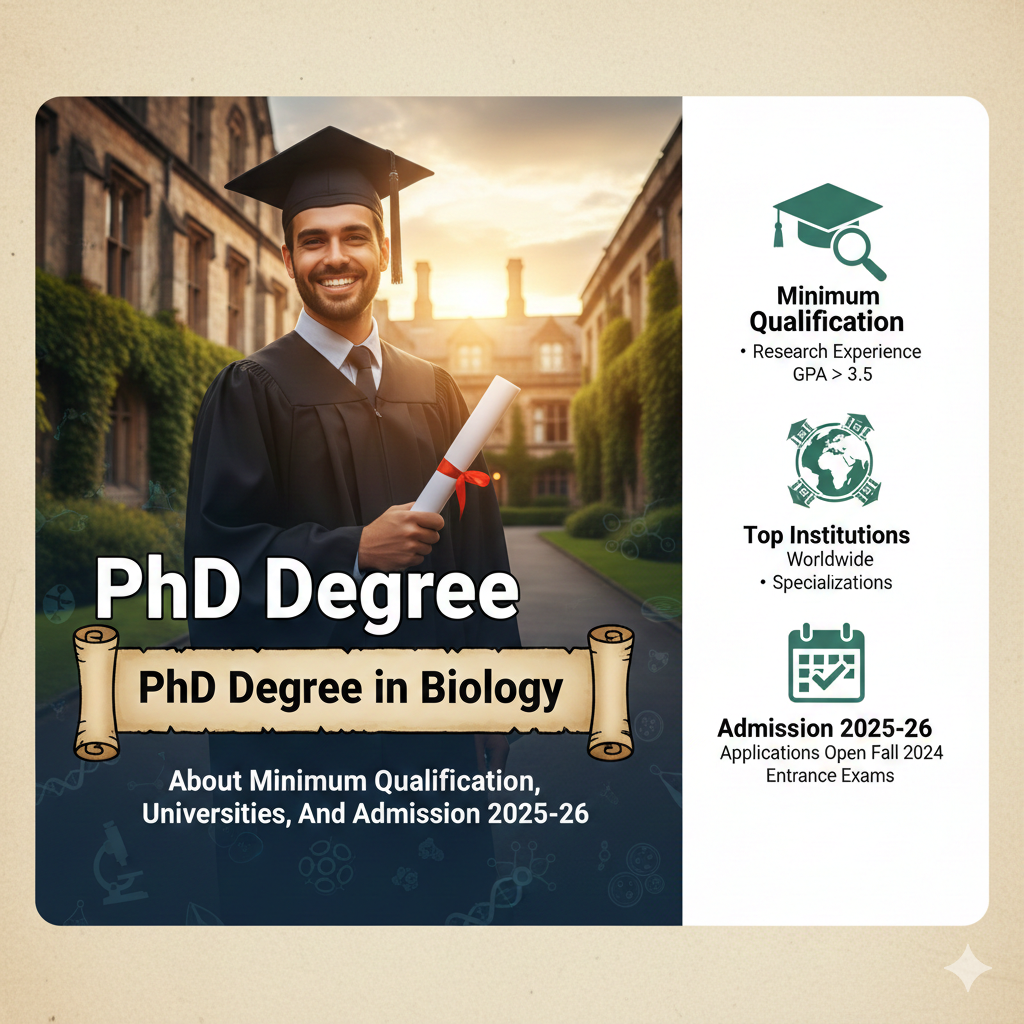
PhD Degree in Biology - About Minimum Qualification, Universities, And Admission 2025-26
About This Course
Biological Sciences reflect humanity’s deep-rooted curiosity about life and the natural systems that sustain it. A PhD in Biological Sciences represents the highest level of academic exploration in this field, placing scholars at the heart of advanced research where discoveries shape the future of science, medicine, and environmental understanding. This journey allows students to explore life in its most intricate forms, from molecular mechanisms inside cells to complex ecological interactions across ecosystems.
Doctoral programs in biology are designed to support intensive, specialized research across diverse domains such as genomics, proteomics, cellular biology, ecology, and evolutionary science. Through structured coursework and independent investigation, PhD candidates develop the skills needed to analyze biological processes, understand disease mechanisms, and explore how living organisms interact with each other and their environments. The research conducted during this program often contributes meaningful insights to the global scientific community and addresses real-world challenges.
The Biology PhD program offered by the College of Science and Technology provides a strong, research-driven academic foundation. Students are immersed in a rigorous learning environment that emphasizes critical thinking, experimental design, and scientific communication. This comprehensive training prepares graduates for a wide range of career opportunities, including postdoctoral research, academic roles, and positions in industries such as biotechnology, bioengineering, healthcare, and pharmaceuticals.
An important advantage of this PhD program is the availability of financial support. Eligible students can receive funding through teaching or research assistantships, along with a tuition waiver, allowing them to focus fully on their academic and research goals. This support system not only eases financial pressure but also enhances professional development through hands-on teaching and collaborative research experience.
Overall, pursuing a PhD in Biological Sciences is more than an academic achievement. It is a commitment to advancing knowledge, solving complex biological problems, and contributing to scientific progress that benefits society and the natural world alike.
Eligibility
To secure admission into a PhD Biology program, candidates must meet specific eligibility requirements set by universities and research institutions. While exact criteria may vary, the following conditions are generally applicable across most colleges.
Applicants should hold a master’s degree in Biology or a closely related discipline from a recognized university or institute. This academic background ensures that candidates possess the foundational knowledge required for advanced biological research. Along with this, a minimum aggregate score of 50% (or equivalent grade) at the postgraduate level is typically mandatory, though some institutions may offer relaxation for reserved categories as per government norms.
Most universities also require candidates to qualify in a recognized entrance examination, such as IIS, BITS Pilani entrance tests, or national-level exams like UGC-NET. These scores help assess a candidate’s subject expertise and research aptitude.
In addition to academic and entrance requirements, applicants must prepare a well-structured research proposal. This document should clearly outline the proposed research topic, objectives, methodology, and expected outcomes. The research proposal plays a crucial role during the personal interview or viva-voce, where candidates are evaluated on their research clarity, originality of ideas, and suitability for the program.
PhD Biology Admission Process
Most institutes admit students to the PhD Biology program through a combination of an entrance examination and a personal interview. As part of the selection process, candidates are required to submit a detailed research proposal outlining the research objective, aim, methodology, and overall approach. This proposal plays a key role during the interview stage, helping the selection panel assess the candidate’s research potential and clarity of thought. A step-by-step guide to the PhD Biology admission process is outlined below.
Online Registration:
The admission process begins with online registration. Institutes open their application portals for a limited period, which is announced through official notifications. Candidates must register within the specified dates and submit their applications only through the official portal.
Fill the Application Form:
Applicants need to carefully complete the application form with accurate personal and academic details. This includes email ID, phone number, educational qualifications, work or research experience, and entrance examination scores. Accuracy is essential, as incorrect information may lead to rejection.
Upload Required Documents:
Candidates must upload scanned copies of mark sheets, certificates, and other required documents. All files should follow the prescribed format, size, and specifications mentioned on the application portal.
Pay the Application Fee:
A nominal application fee must be paid to process the form. Most institutes accept payments through standard online methods such as debit cards, credit cards, or net banking.
Entrance Examination:
Once eligibility is confirmed, candidates are allowed to appear for the entrance examination. Admit cards can be downloaded from the portal. After the exam, results are typically declared within a few weeks.
Personal Interview:
Candidates who qualify the entrance exam are shortlisted for a personal interview. During this stage, applicants must present and discuss their research proposal with the interview panel.
Final Admission:
Based on overall performance, a final merit list is released. Selected candidates can confirm their admission by completing formalities and paying the admission fee.
Future Scope
PhD Biology graduates are in strong demand across both government organizations and private research laboratories. Their advanced expertise allows them to work in a wide range of sectors, including educational institutions, medical research centers, zoos, national parks, and conservation agencies. These roles often involve research, teaching, policy support, and applied scientific work focused on health, environment, and sustainability.
The starting salary for PhD Biology candidates is generally on the higher side, reflecting the level of specialization and research experience they bring. Initial monthly earnings typically range from INR 25,000 to INR 85,000, depending on factors such as skills, research output, prior experience, and the hiring organization. With time, experience, and continued contributions, salary growth can be substantial.
Graduates are recruited into diverse job profiles, including Microbiologist, Environmental Laboratory Scientist, Natural Science Manager, Professor, Research Associate, and similar research-driven or leadership roles. Many PhD holders secure employment immediately after completing their degree, while others continue working professionally alongside their doctoral studies.
A PhD represents the highest academic qualification in India, and it significantly enhances employability. Doctorate holders are highly valued for their analytical thinking, problem-solving ability, and subject mastery, making job opportunities relatively accessible across sectors. While most candidates choose to enter the workforce directly after graduation, some may also explore alternative academic or research-oriented study paths to further specialize or transition into interdisciplinary fields.
No universities found offering this course yet.
Apply for PhD Degree in Biology - About Minimum Qualification, Universities, And Admission 2025-26 at